BIG support for the little guys!


Or, Why Most Households Are Paying for Internet They’ll Never Use
Technology companies love big numbers.
The bigger the number, the better the product must be… right?
It’s why you’ll see advertisements promoting 1 Gigabit, 1.5 Gigabit, and even 2 Gigabit internet connections. The marketing suggests that anything less will leave you buffering videos, lagging during games, and struggling to keep up with modern technology.
But here’s a question worth asking:
Do you actually need it?
For many households, the answer is surprisingly simple.
Probably not.
At SingleBuck, we believe people should understand what they’re buying before they spend their money. That doesn’t mean high-speed internet is a scam, and it doesn’t mean there aren’t situations where faster connections make sense.
What it does mean is that many people are paying for significantly more internet than they actually use.
Let’s talk about why.
The Speed Race
Internet providers are competing in a market where most customers don’t understand the technical details behind what they’re purchasing.
As a result, providers focus on something that’s easy to market:
Speed.
It’s easy to advertise.
100 Mbps sounds slower than 500 Mbps.
500 Mbps sounds slower than 1 Gigabit.
1 Gigabit sounds slower than 2 Gigabit.
The assumption becomes:
“More speed must equal a better internet experience.”
But that isn’t always true.
A faster internet package doesn’t automatically make websites load faster, games perform better, or videos look clearer.
Many people are surprised to learn that their internet experience is often limited by factors completely unrelated to the speed package they purchase.
What Does Internet Speed Actually Mean?
When internet providers advertise speed, they’re referring to the maximum amount of data that can travel through your connection at any given moment.
Think of it like a highway.
A wider highway can move more cars at the same time.
However, if there are only a few cars on the road, adding more lanes doesn’t make the trip any faster.
That’s exactly how internet speed works.
If your household only uses a fraction of your available bandwidth, increasing the size of the connection doesn’t create a noticeable difference.
You simply have more unused capacity.
How Much Bandwidth Common Activities Use
One of the biggest misconceptions surrounding internet service is how much speed everyday activities actually require.
Let’s look at some common examples.
Browsing Websites
Most websites use very little bandwidth once loaded.
Typical usage:
1–5 Mbps
Social Media
Facebook, Instagram, TikTok, X, and similar services consume surprisingly little bandwidth compared to what people imagine.
Typical usage:
2–10 Mbps
Video Calls
Zoom, Microsoft Teams, Google Meet, and FaceTime generally require:
HD Video:
3–5 Mbps
Full HD Video:
5–8 Mbps
Streaming Video
This is where many people assume they need ultra-fast internet.
In reality:
Netflix HD:
5 Mbps
Netflix 4K:
15–25 Mbps
YouTube 4K:
15–30 Mbps
Even multiple streams running simultaneously often use less bandwidth than most people expect.
Online Gaming
This is perhaps the most misunderstood category of all.
Most online games use remarkably little bandwidth.
Many games average:
1–5 Mbps
Some use even less.
What gamers actually care about is latency.
Latency is how quickly information travels between your device and the game server.
A 100 Mbps connection with excellent latency often provides a better gaming experience than a 2 Gigabit connection with poor latency.
More speed does not automatically mean lower lag.
The Difference Between Speed and Latency
Imagine ordering a pizza.
Bandwidth determines how many pizzas can fit in the delivery car.
Latency determines how quickly the first pizza arrives.
Most people focus entirely on bandwidth.
But when you’re gaming, using video calls, or browsing websites, latency often has a bigger impact on your experience.
This is why some people upgrade to faster internet and notice absolutely no difference in gaming performance.
They increased bandwidth.
Their latency stayed exactly the same.
The Household Reality Check
Let’s imagine a typical family.
One person is streaming Netflix in 4K.
Another is watching YouTube.
Someone is scrolling social media.
A teenager is playing an online game.
Several phones are connected.
A smart TV is running.
Maybe there are a few smart home devices online.
Total bandwidth usage?
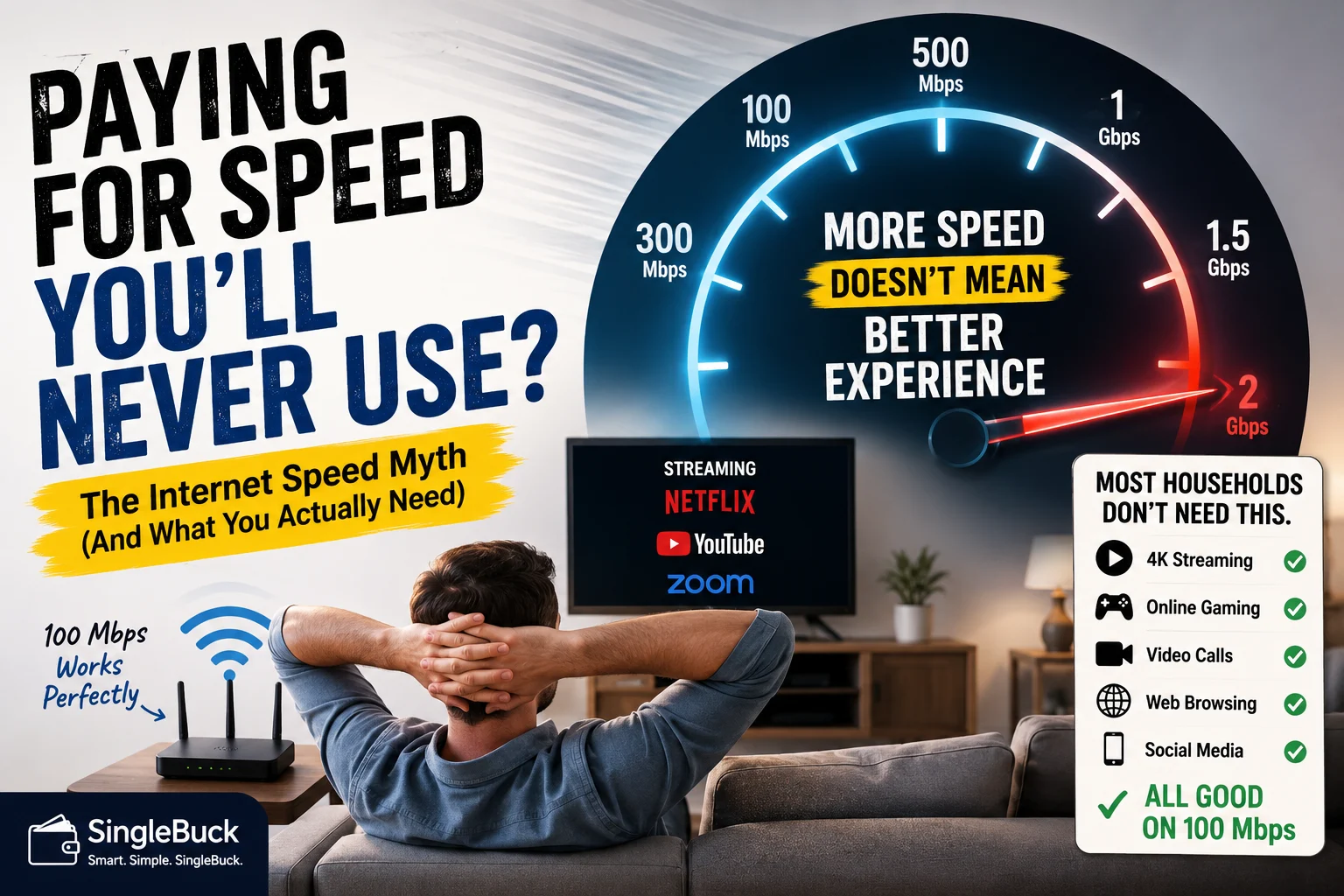
Often well under 100 Mbps.
That’s not a typo.
Many households that subscribe to 1 Gigabit internet rarely use even one-tenth of the capacity they pay for.
The Hidden Bottlenecks
Even if you purchase a 2 Gigabit connection, that doesn’t mean you’ll experience 2 Gigabit speeds.
Several factors can limit performance.
Your Router
Many routers cannot consistently deliver maximum advertised speeds throughout an entire home.
Wi-Fi
Walls, distance, interference, and device limitations all affect wireless performance.
Your Devices
Older laptops, phones, tablets, and computers may not support ultra-high-speed networking.
The Website You’re Using
The server on the other end must also be capable of sending data at those speeds.
If a website only delivers data at 100 Mbps, your 2 Gigabit connection provides no advantage.
Who Actually Benefits from Gigabit Internet?
Gigabit internet isn’t useless.
There are absolutely situations where it makes sense.
Examples include:
- Video production studios
- Businesses with many users
- Technology enthusiasts
- Home server operators
- Large families with extremely heavy internet usage
- Frequent downloads of massive files
- Professional content creators
For these users, faster connections can provide real benefits.
The important point is that they represent a minority of internet users.
Most households do not fit into these categories.
The Marketing Problem
Marketing isn’t necessarily lying.
The speeds being advertised are real.
The problem is that advertisements often encourage customers to believe they need more speed than their actual usage requires.
Nobody wants to feel like they’re settling for less.
So people choose the biggest package they can reasonably afford.
The result?
Millions of households paying for internet capacity that sits unused most of the time.
Bigger Isn’t Always Better
At SingleBuck, we see this same pattern throughout the technology industry.
More storage.
More RAM.
More hosting resources.
More internet speed.
Bigger numbers make excellent advertisements.
But bigger numbers don’t always create a better experience.
The smartest purchase isn’t usually the largest package available.
It’s the package that matches your actual needs.
The Bottom Line
If you’re experiencing buffering, slow downloads, or poor internet performance, a faster package may help.
But before upgrading, ask yourself a few questions:
- How many people actually use the connection?
- What activities are they performing?
- Is the issue speed, Wi-Fi coverage, or latency?
- Are you upgrading because you need more bandwidth or because the marketing convinced you that bigger is better?
For many households, the answer is simple.
You already have enough speed.
You just don’t have enough information.
And understanding the difference could save you money every single month.
At SingleBuck, we believe technology should work for people, not marketing departments. Our goal isn’t to sell you the biggest number. It’s to help you understand what you actually need.