
BIG support for the little guys!


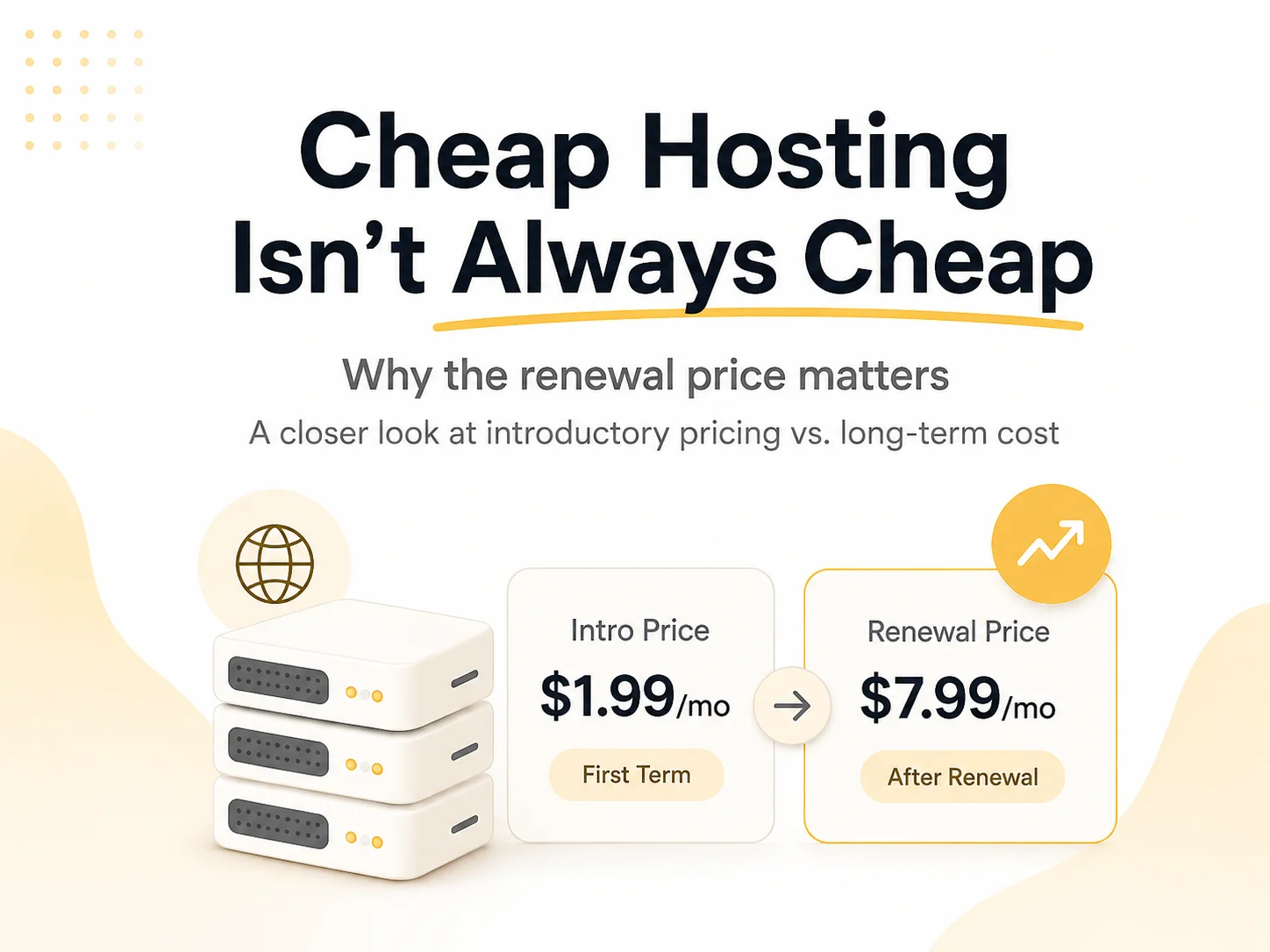
Why the Renewal Price Matters
That $2.99 or $4.19 hosting plan can look like an incredible deal. But what happens when the introductory period ends?
When people compare web hosting, the first number they usually notice is the monthly price.
$2.99 a month.
$4.19 a month.
$5.49 a month.
Those numbers are designed to get attention—and there is nothing inherently wrong with offering an introductory discount. Promotions can be a perfectly legitimate way for a company to attract new customers.
The problem is that the price you see when you sign up and the price you pay when you stay can be very different things.
For a small business, creator, nonprofit, entrepreneur, or someone simply trying to keep a website online without spending a fortune, that difference matters.
A lot.
The hosting price people compare is often not the long-term price
Web hosting has become an extremely competitive industry.
Large providers compete for customers through search results, advertising, affiliate programs and comparison websites. One of the easiest ways to stand out is with a very low introductory monthly price.
But introductory pricing creates an interesting problem.
A customer might choose one provider over another because one appears to cost $3 or $4 per month. Once the customer has moved their website, configured their email, connected their domain, uploaded their content and spent a year—or several years—using the service, moving somewhere else becomes considerably less attractive.
That is when the regular price becomes much more important than the promotional one.
And the difference can be significant.
A real example: Hostinger
At the time of writing, Hostinger Canada’s Premium hosting plan is advertised at C$4.19 per month when purchased as a 48-month term.
The same page states that the plan renews at C$15.39 per month.
That means the monthly-equivalent price at renewal is approximately 267% higher than the introductory rate.
Hostinger’s Cloud Startup plan provides another example. It is currently advertised at C$11.19 per month, while the published renewal rate is C$36.29 per month.
That works out to an increase of roughly 224% from the introductory monthly-equivalent price.
Hostinger isn’t hiding these numbers. The renewal rates are published directly on its pricing page, which is a good thing.
But it illustrates why consumers need to look beyond the large promotional number.
C$4.19 per month and C$15.39 per month describe two very different long-term costs.
SiteGround shows an even larger difference
SiteGround currently advertises its StartUp hosting plan at $2.99 per month, prepaid for 12 months.
On the same page, SiteGround states that the plan renews at $17.99 per month.
The difference between those two prices is approximately 502%.
Its GrowBig plan follows a similar pattern: $4.99 per month initially, renewing at $29.99 per month—about a 501% increase from the promotional rate.
GoGeek is currently advertised at $7.99 per month and renews at $44.99 per month, an increase of approximately 463% over the introductory rate.
Again, SiteGround publishes the renewal prices. This isn’t about suggesting that the company is concealing them.
It’s about understanding what “cheap hosting” actually means.
A $2.99 promotional price can become a $17.99 regular price.
Those are not remotely the same budget.
GoDaddy uses first-term pricing too
GoDaddy Canada’s current web hosting page also makes an explicit distinction between promotional and regular pricing.
Its Economy hosting plan currently displays C$5.49 per month for the first one-year term, alongside a higher displayed standard price of C$16.99.
Deluxe is shown at C$7.49 per month for the first one-year term, alongside C$22.99, while Ultimate is shown at C$9.99, alongside C$29.99.
Because GoDaddy’s current public page describes these specifically as first-term promotional prices rather than explicitly labelling every higher displayed figure as the renewal rate, we’re not going to pretend those figures mean something the company doesn’t say.
But the pricing presentation demonstrates the same broader point:
The price advertised most prominently may represent the beginning of the relationship—not necessarily its long-term cost.
And that’s the number customers should be thinking about.
Promotional pricing isn’t the problem
We want to be fair about this.
There is nothing automatically dishonest about introductory pricing.
If a hosting company clearly says:
Your first term is $4.99 per month. After that, your regular price is $19.99 per month.
…then the customer has been given the information needed to make a decision.
Hosting companies also have real expenses. Servers cost money. Bandwidth costs money. Support costs money. Software licences, security, backups, infrastructure, employees and development all have costs attached to them.
A sustainable hosting company needs sustainable pricing.
The issue isn’t that hosting should be impossibly cheap forever.
The issue is what happens when an extremely low introductory price becomes the number customers use to judge affordability—even though it may bear little resemblance to what they’ll eventually pay.
Loyalty shouldn’t make something dramatically more expensive
This is the part of the traditional pricing model that has always felt backwards to us.
Think about the relationship from the customer’s perspective.
You sign up.
You trust the company with your website.
You connect your domain.
You build your business.
You configure everything.
You stay.
And then the reward for remaining a customer is… paying dramatically more for essentially the same core service?
We don’t think long-term customers should be valuable because they are inconvenient to lose.
We think they should be valuable because they chose to stay.
That distinction is one of the reasons the SingleBuck Price Guarantee exists.
SingleBuck takes a different approach
SingleBuck wasn’t built around the idea that we need to recover an artificially low signup price through a dramatic renewal increase later.
Our regular pricing is intended to be sustainable from the beginning.
For eligible services covered by the SingleBuck Price Guarantee, the core signup price for the same service and billing term remains protected while that service stays continuously active and in good standing.
That doesn’t mean every possible charge can never change.
Taxes can change. Domain registry costs can change. Third-party fees can change. Customers can add services, increase resources, upgrade plans or request additional work.
Those are different costs.
But we don’t believe staying with SingleBuck should, by itself, become the reason we suddenly charge you dramatically more for the same eligible core service. Our published guarantee specifically distinguishes protected core pricing from things such as additional products, upgrades, usage costs, taxes and third-party pass-through charges.
It’s a pretty simple philosophy:
The price shouldn’t explode just because you stayed.
Compare the second price, not just the first one
When shopping for hosting, looking at the introductory price is perfectly reasonable.
Just don’t stop there.
Before choosing a provider, find out what happens after the promotional period. Look for the regular renewal price, how long the initial commitment lasts, whether the displayed monthly rate requires paying several years upfront, which features are temporary, and whether things such as domains, email, SSL certificates or backups have separate renewal costs.
For example, Hostinger’s C$4.19 Premium price currently requires purchasing 48 months upfront, and its own pricing page explains that the displayed monthly figure is the total plan price divided by the number of months in the term.
That context changes how useful the headline monthly number really is.
There can be an enormous difference between:
“What does this cost me today?”
and:
“What does this cost me to keep?”
For a business website that may remain online for five, ten or twenty years, we think the second question is considerably more important.
Cheap should still be cheap after you become a customer
SingleBuck was built for creators, entrepreneurs and small businesses—the people for whom an unexpected additional $10, $20 or $30 every month can actually matter.
We don’t believe affordable pricing should only exist during the period when we’re trying to earn your business.
It should still matter after we’ve earned it.
There will always be hosting companies bigger than SingleBuck. There will always be promotions with enormous percentages attached to them. And occasionally somebody will advertise a first-year price that we simply aren’t interested in trying to beat.
That’s okay.
Our goal isn’t to win the contest for the smallest number in an advertisement.
It’s to offer a fair price we can stand behind after the advertisement is over.
Because sometimes the cheapest hosting isn’t the plan with the lowest price on day one.
It’s the one that still feels affordable when year two arrives.